

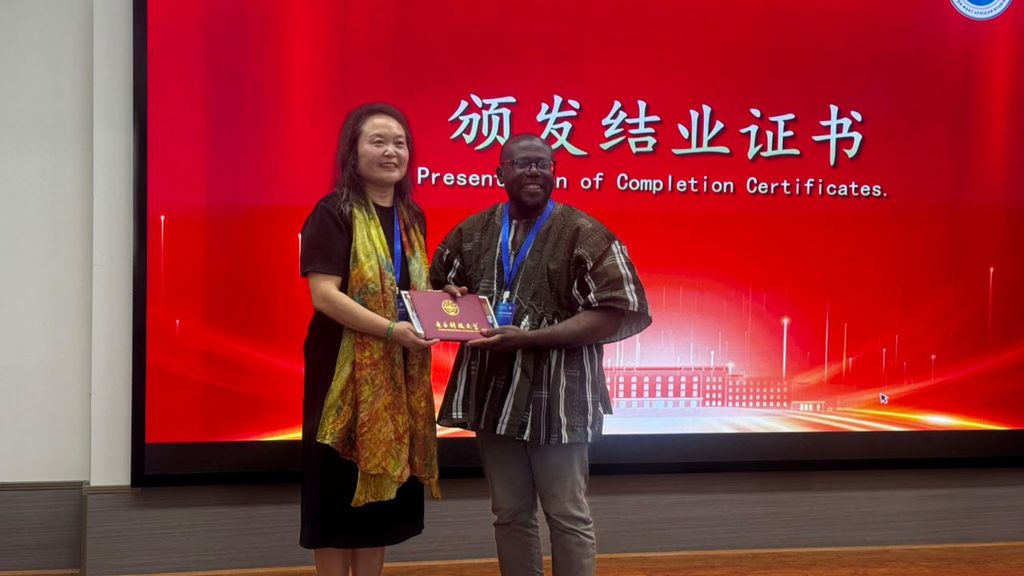
The Ghana Institute of Management and Public Administration (GIMPA) is proud to announce the successful conclusion of the 2026 Ghana Governance Training Program, held at the Shahe Campus of the University of Electronic Science and Technology of China (UESTC).
A delegation of fifteen participants, comprising representatives from Ghanaian universities and local public administration departments, completed the intensive program. The delegation was led by the Rector of GIMPA, Professor Samuel Kwaku Bonsu, who attended the opening ceremony and participated in key institutional engagements.
Strengthening China-Africa Educational Cooperation
Jointly organized by the Centre for West African Studies of UESTC and the UESTC Base for Sichuan Provincial Cadre Education and Training, the program formed a core part of the Centre’s 2026 China-Africa Year of People-to-People Exchanges series. Marking the 70th anniversary of diplomatic relations between China and African countries, the initiative aimed to implement the spirit of President Xi Jinping’s visionary outreach and foster mutual learning in public governance and talent development between China and Ghana.
During the opening ceremony on September 24, Professor Zheng Yutao, Secretary of the CPC Committee of UESTC’s School of Public Administration, and Liu Quansheng, President of the Sichuan Provincial People’s Association for Friendship with Foreign Countries, welcomed the Ghanaian delegation, emphasizing the importance of deepening local exchanges, shared governance experiences, and enduring bilateral friendships.

Comprehensive Curriculum and Expert Modules
The training program was structured around three dynamic modules encompassing global and regional governance, digital and smart governance, and urban-rural industrial development. Participants attended expert-led lectures and interactive discussions conducted by distinguished scholars from UESTC, Capital University of Economics and Business, and Sichuan University. Sessions covered critical topics such as China’s reform and opening-up experience, digital communication in local governance, smart city reforms, human-machine collaborative media production, and digital public governance empowering educational services.

Immersive Field Studies and Rural Revitalization
To bridge theory with practical application, the Ghanaian delegation combined rigorous classroom sessions with extensive field observations across Chengdu. Participants explored technological innovation, ecological conservation, and grassroots community services through visits to the UESTC Electronic Science and Technology Museum, the Chengdu Science Fiction Museum, local community governance sites in Chenghua District, and the Chengdu Museum.
A particular highlight of the field studies was the focus on rural revitalization in Pidu District’s Zhanqi Village and Qinggangshu Village. Participants observed firsthand how local communities leverage ecological preservation, collective property rights reforms, and cultural tourism to drive rural industries and enhance household incomes, offering valuable comparative lessons for rural development frameworks in Ghana.
Looking Ahead
The program officially concluded with a closing ceremony on October 2, where participants were awarded certificates of completion. Both GIMPA and UESTC expressed a shared commitment to ensuring that the conclusion of the program marks the beginning of deeper, long-term collaboration. Moving forward, both institutions will continue to explore joint initiatives in digital governance, public administration, and urban-rural development through ongoing academic exchanges and research partnerships.
